
An acoustic-electric guitar has two demonstrations to pass: the instrument in the player’s hands and its output through a suitable sound system. Give each a clear turn. A polished amplified sound should not hide an uncomfortable instrument, and an attractive acoustic sound does not prove that the pickup system meets the player’s needs.
For the 2027 NAMM Show, scheduled January 26-30 with exhibits January 28-30, use the same test across appointments. Keep the model, system, and listening conditions in your notes so observations remain useful after the show.
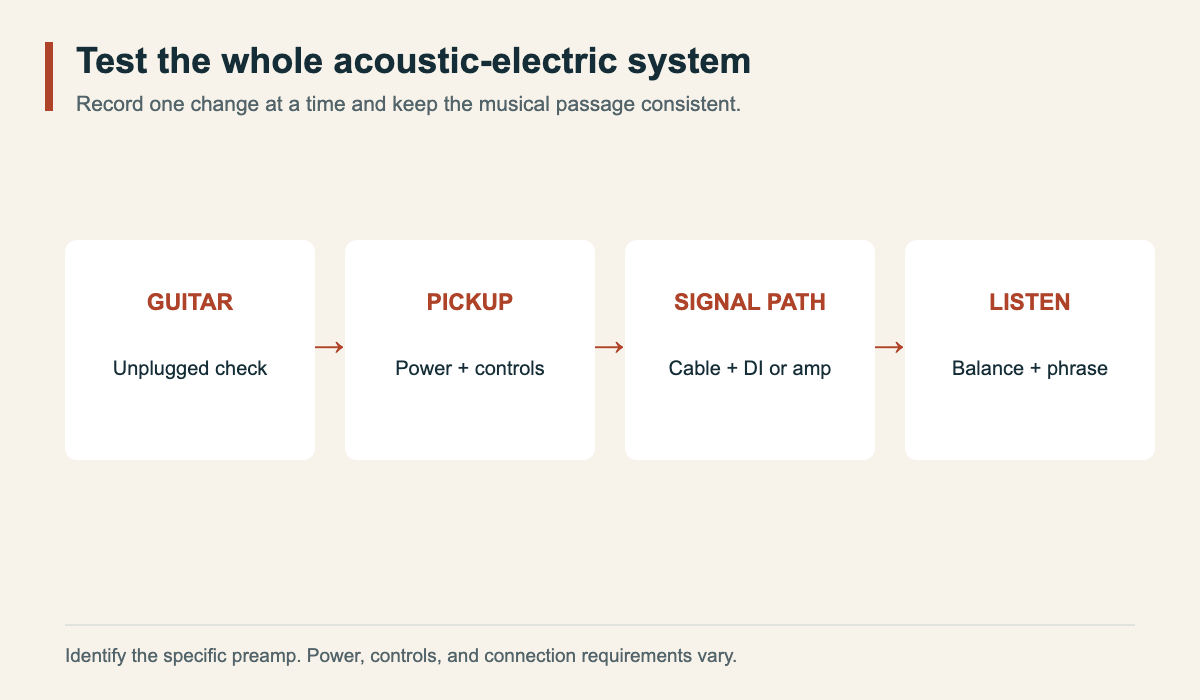
Begin without the cable
Tune the guitar, identify the fitted strings where possible, and ask the player to use a familiar passage. Include chords, single notes, and the dynamics relevant to the intended use. Check seated or standing position, reach, and access to the controls.
Write down what you heard and felt before plugging in. If the instrument is being demonstrated in a noisy room, note that limitation rather than treating a brief unamplified impression as a definitive tonal assessment.
Establish a known signal path
Identify the pickup and preamp system fitted to the actual model. Check the specified power source and its condition. Use a known working cable and an appropriate acoustic amplifier, DI and mixer, or other suitable system.
Begin with a documented neutral starting point where the equipment allows it. Set a moderate level and avoid using effects to conceal a basic problem. If a control or routing option is unfamiliar, consult the manual or ask the demonstrator to explain it before changing several things at once.
Listen to each string
Play the strings individually with a reasonably consistent attack, then perform the same musical passage. Listen for balance and unwanted noise. A difference can arise at several points in the system; change one element at a time when investigating.
Check the controls one at a time. A tuner, phase switch, notch control, blend, or EQ may be present, but features vary by system. Do not promise a function because a similar-looking guitar had it.
Test the intended use within sensible limits
A solo performer, ensemble guitarist, and school user may need different output arrangements. Ask how the instrument will connect to the actual venue or classroom equipment, who will operate it, and what accessories are already available.
Discuss feedback controls in relation to the specific system and manual. Do not create a loud feedback event on a busy show floor simply to prove a point. A controlled later trial can answer questions the booth cannot resolve.
If the preamp switches on through the output jack, follow its instructions about unplugging when not in use. That behavior is common but should be checked for the actual system. Battery type, access, and replacement procedure belong in the handoff.
Record the whole order
List the instrument, case, required cable, power consumables, any agreed DI or amplification, preparation, and support. Identify optional accessories separately from items needed to make the proposed setup work.
For a dealer evaluating a line, keep availability and service questions beside the musical observations: current model information, replacement parts, technical support, and the terms supplied for the order. A demonstration does not settle those commercial details.
Leave with an observation you can reproduce
Write one sentence about the result, one about the conditions, and one about anything that still needs testing. "Even string balance through this DI at the recorded settings" is more useful than "great plugged-in sound."
Use SBO+'s teaching-tool evaluation sheet when the intended customer is a school. It gives the educator a matching way to describe the musical task the equipment must support.