
The first strummed chord often sells the appeal of a 12-string guitar. The rest of the demonstration should establish whether the player can use that sound comfortably, keep it in tune, and maintain the instrument they are considering.
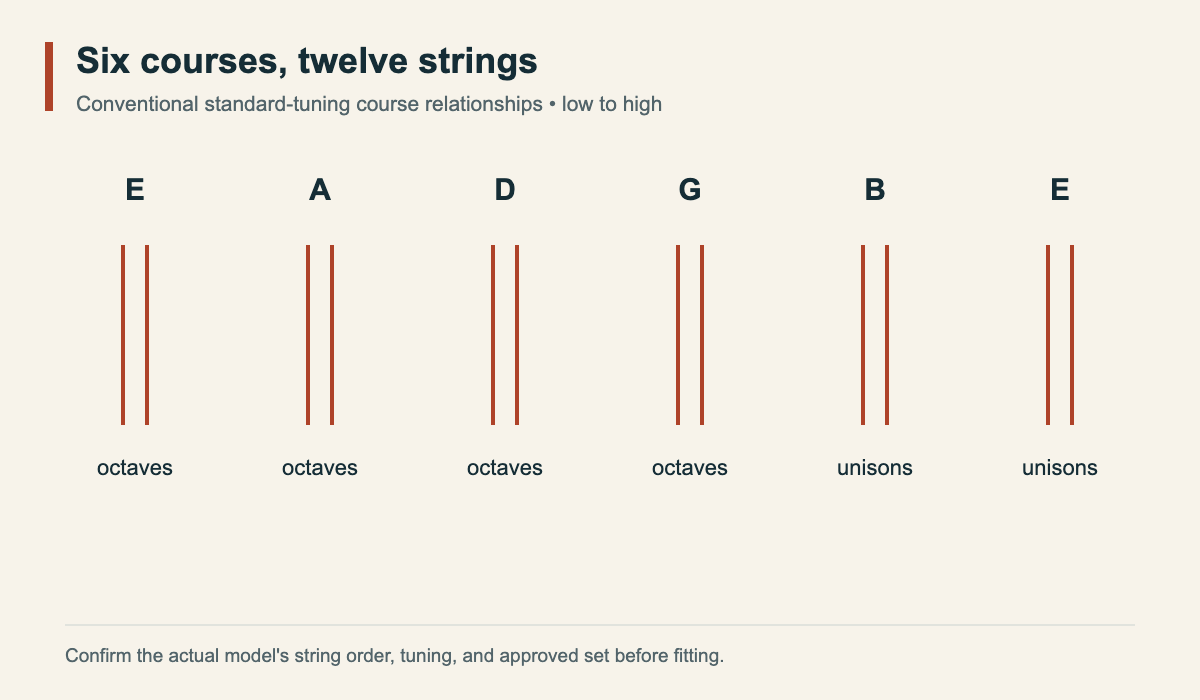
Most conventional 12-string guitars group the strings into six courses. In standard tuning, the four lower courses commonly pair notes an octave apart, while the two upper courses use unisons. Confirm the string order and tuning for the actual model; familiar conventions are not a substitute for its instructions.
Ask where the sound belongs
Find out whether the customer wants a primary instrument, a recording color, an accompaniment guitar, or a particular ensemble role. Have them play the kind of part they expect to use. A few open chords may reveal the attraction without showing what the instrument asks of the fretting hand over a complete phrase.
Compare an arpeggio, a sustained chord, and a short passage with chord changes. Let the customer play sitting and, if relevant, standing with a suitable strap. Watch reach and balance, then ask for the player’s own account of comfort.
Tune each course carefully
Use a tuner that can resolve the intended pitches and explain which member of the course is being tuned. Work through the instrument systematically, then recheck. A player new to octave courses can otherwise chase a pitch in the wrong register.
Keep the maker's recommended set and tuning with the display instrument. Do not generalize a gauge recommendation from one brand or model to every 12-string. If a customer wants a heavier set or a different tuning, establish the manufacturer's guidance and any needed setup before making the change.
Taylor's published reference, for example, distinguishes its acoustic 12-string sets from its T5z 12-string sets. That is a reminder to identify the instrument, not a reason to apply Taylor's specifications elsewhere.
Test the chords the customer will actually play
Check first-position chords, a barre shape if it is part of the player’s vocabulary, and a phrase farther up the neck. Listen for clean paired notes, unintended muting, buzz, and tuning behavior. Repeat the comparison at a realistic playing dynamic.
If the customer finds the instrument hard to play, distinguish reach, fretting effort, and setup. A technician can evaluate the instrument. Avoid promising that a string change alone will solve an unidentified problem.
For used instruments, document visible condition and refer structural or setup concerns to the shop's qualified service staff. Keep the inspection and any work performed with the instrument's record.
Include the amplified test when needed
On an acoustic-electric model, listen unamplified and through an appropriate system. Check the controls, pickup balance, power requirements, and the included accessories. Identify what was tested and at what settings.
The doubled strings can make subtle differences interesting to hear. They can also make a casual comparison difficult. Use the same passage and approximately matched listening level when comparing instruments.
Send the specification home
The handoff should identify the model, fitted set, tuning, case, and any service arrangement. Demonstrate how to find the correct replacement strings and how the store handles a restring or setup booking.
A 12-string should leave the shop as a particular instrument with known requirements. Its distinctive sound is the beginning of the sale; a usable playing and maintenance plan completes it.