
A school buyer asking for a snare drum may be equipping a concert ensemble, a drum set, or a marching section. Clarify the job before comparing shells and prices. Instruments sold under the same broad name can make very different demands on players, stands, heads, and service.
Ask where the drum will be played, what repertoire or style it must serve, who will use it, and how it will be supported. Those answers establish the demonstration the store needs to provide.
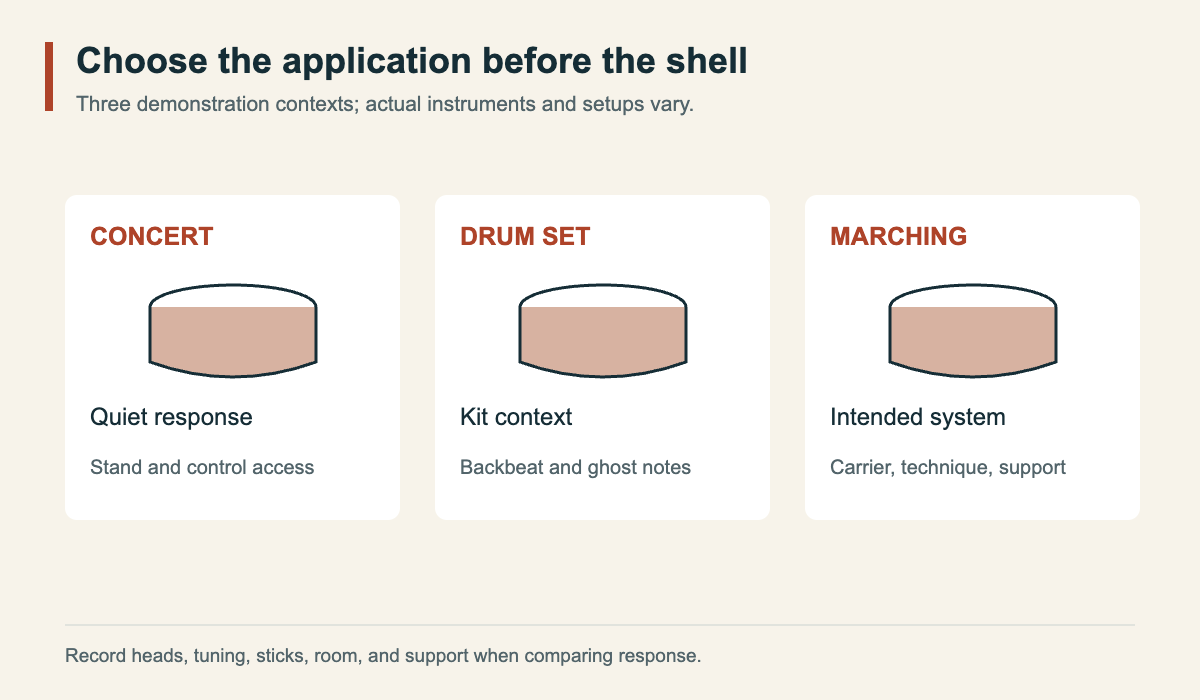
Start with the musical response
For a concert application, ask the player to try quiet isolated strokes, a controlled roll, an accented passage, and a short phrase at a stronger dynamic. Listen to the response at the levels the music actually requires.
For drum set, include the player’s normal backbeat, ghost notes if relevant, and interaction with the rest of the kit. For marching, involve the instructor or specialist responsible for the intended technique and equipment system. Do not apply a high-tension marching approach to a drum that was not designed for it.
The same shell material can appear in instruments with different construction and setup. A material label alone cannot predict whether the drum will meet the task.
Compare under known conditions
Record head type, tuning approach, snare setting, sticks, room, and listening position when making a meaningful comparison. Keep the musical test consistent. If one drum is demonstrated at an unsuitable tension or with worn heads, the comparison may say more about preparation than the instrument.
Ask the demonstrator to show the snare mechanism engaged and disengaged. Listen for the change, check that the mechanism operates as intended, and identify the adjustments the player or technician will actually use.
No single tuning is correct for every application. Follow the maker's guidance and have qualified staff prepare the instrument for the intended test.
Check the support before the order
A concert stand must support the drum securely at the player’s working height. A drum-set stand must fit the kit and player. A marching purchase may need a compatible carrier, stand, covers, and transport arrangements. Confirm the actual hardware rather than assuming that it is included.
Have the player approach the drum in the intended position. Can the stand reach the right height? Is the instrument stable? Are the snare controls accessible? An excellent sound does not resolve a poor working position.
Quote the complete setup
List the drum, support hardware, case, appropriate sticks, spare heads or other agreed service items, and any preparation included in the price. For schools, identify replacement sources and the process for future maintenance.
Explain care using the instrument maker's instructions. The thin resonant head and snare components need appropriate handling; they are not interchangeable with every other drum surface. Label the case and storage arrangement so staff and students know how the drum is meant to travel.
Make the decision easy to explain
Use a comparison record that describes observed response, usable dynamic range for the task, working position, service needs, and complete cost. Do not turn that record into a universal ranking of brands.
For the teacher's side of the discussion, pair this guide with SBO+'s classroom-percussion selection article. The shared question is concrete: Which musical role must the instrument perform, and can the intended player control it in the intended setting?