
"What strings do you recommend?" is a short question with several missing details. The answer depends on the instrument, the tuning, the installed set, and what the player wants to change. Establish those facts before reaching for a packet.
A useful first question is: "What is on the guitar now, and what would you like it to do differently?" If the player does not know the current set, write that down. A guess becomes harder to correct once it has been treated as a specification.
Identify the instrument and its job
Confirm whether the guitar is built for nylon or steel strings, its model, its scale length where relevant, and its usual tuning. Ask whether the player mainly strums, bends, fingerpicks, records, or performs amplified. The answers describe a use; they do not automatically dictate a brand.
An acoustic guitar and an electric guitar may accept packets with similar gauge labels while needing different string constructions. Do not substitute steel strings for nylon on an instrument designed for nylon. Consult the instrument maker when compatibility is unclear.
Read the complete set
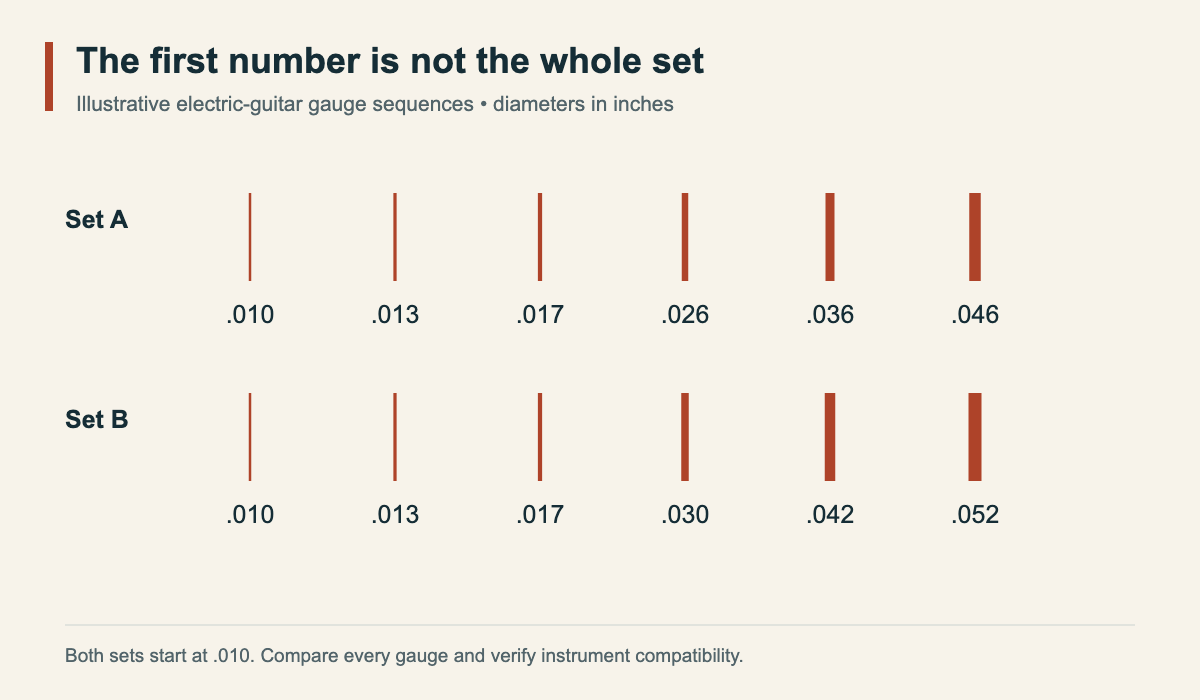
String gauge is diameter, commonly stated in thousandths of an inch. A player asking for "10s" is usually naming the high string's .010-inch diameter. Two sets beginning there can have different lower-string gauges. Read the full sequence, particularly when a player uses dropped tuning or a mixed set.
A change in gauge or construction can alter feel and the instrument's setup. Offer a service evaluation when the requested change is substantial or the player already reports excessive effort, buzzing, or unreliable intonation. A lighter set may change the experience; it does not diagnose the cause of a difficult action.
Explain tension without overpromising
For a particular string, vibrating length and pitch affect tension. Construction and mass matter too. Equal diameter does not guarantee equal tension across different strings, and perceived stiffness also involves the instrument and the player’s technique.
Use the manufacturer's tension information for an actual comparison rather than turning a gauge label into a universal rule. Avoid declaring a set easier, louder, or better for everyone. Ask the player to compare it in the context that prompted the purchase.
Make material and coating a choice
Present material, winding, and coating as choices with audible and tactile consequences. A player seeking a brighter attack, a smoother surface, or a longer interval between changes may value different features. Keep the explanation tied to the specific product's documentation.
For coated and uncoated alternatives, show the actual prices and ask how the instrument is used and cared for. Do not promise a fixed life span. Hours of playing, handling, storage, and the player’s tolerance for changes in sound all affect replacement decisions.
Finish with a usable record
Write the brand, product code, complete gauges, tuning, and installation date on a card or the store's service record. Note any planned setup work. Give the player the packet or a photograph of its label so the next purchase begins with evidence.
If a string repeatedly breaks in the same place, record the location and refer the instrument for inspection rather than simply selling a heavier replacement. A recurring symptom deserves a service question.
A good string recommendation leaves the player able to explain what was fitted and why. That record also gives the next staff member a much better starting point than "the blue packet I bought last time."