
"Long scale" on a bass-string packet is a starting description, not a complete fitting instruction. Two basses with the same nominal scale can route their strings differently, and that extra path can matter before the string reaches the nut or tuner.
Begin with the exact instrument and bridge arrangement. Then compare the string maker's usable winding length and installation requirements. The sale is complete when the whole set fits, not merely when its gauge looks familiar.
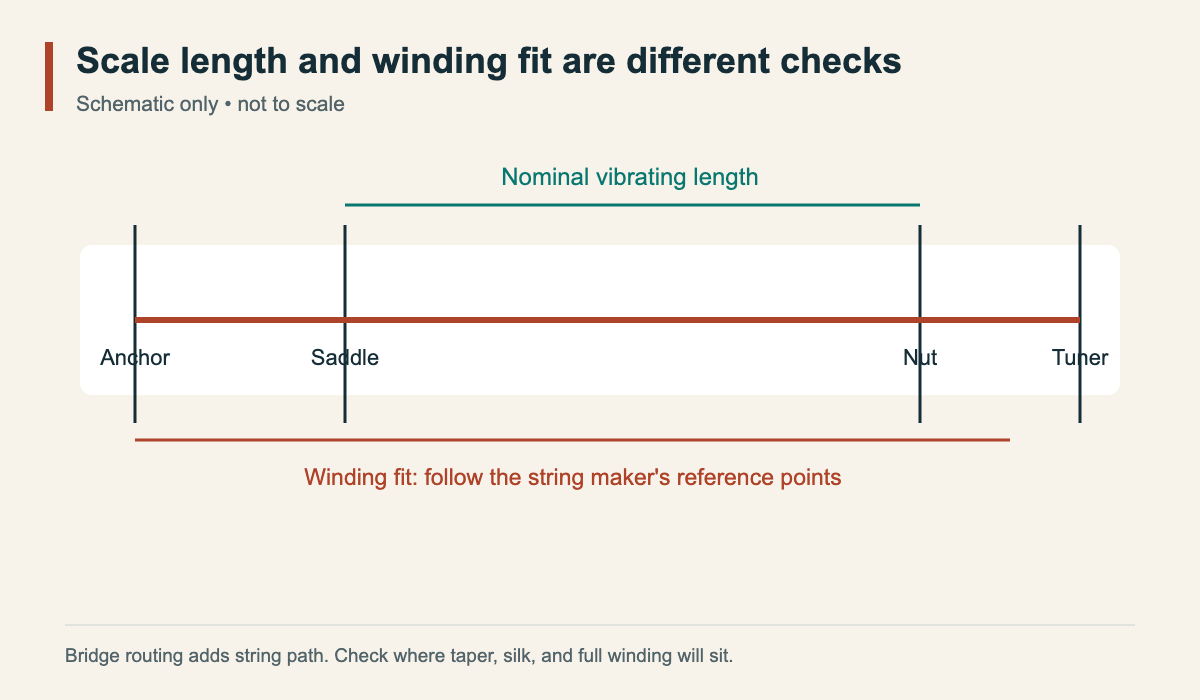
Keep three measurements distinct
The instrument's nominal scale describes its vibrating length. The string's total length describes the material supplied. The relevant wound or speaking section must suit the route from its anchor, over the saddle, through the nut, and into the tuner as required by the design.
A string-through-body bridge can require more length behind the saddle than a top-loading arrangement. Headless and other specialized designs may impose different anchoring requirements. Identify those features before selecting the packet.
D'Addario, for example, publishes bass-string length information from the ball-end reference to the taper and tells users how to compare that measurement with their instrument. Other manufacturers may describe their products differently. Follow the instructions for the specific set.
Inspect where the construction changes
Find out where taper, exposed core, silk, or full winding would sit after installation. The intended section should bear over the saddle and nut according to the string and instrument makers' guidance. Do not assume any transition is acceptable at any contact point.
Where fit is uncertain, ask for dimensions or consult the maker before trimming a string. A cut packet and an irreversible cut turn a solvable question into a more expensive one.
Treat flatwound as a construction choice
Flatwound strings have a smoother outer winding profile than conventional roundwounds. Players may seek their surface feel, attack, or sustained character. Those preferences still need a comparison on a suitable instrument; construction does not determine one universal sound in every rig.
Ask what the player currently uses and which quality they want to change. Keep pickup settings, amplification, and the musical phrase consistent during a trial. If a demonstration instrument differs materially from the customer's bass, explain that limitation.
Changing construction or gauges may call for setup work. Do not promise an interchangeable feel solely because both packets list the same diameters.
Give the fifth string its own check
On a five-string bass, identify the intended tuning. A low-B set and a high-C arrangement are different requests. A short-scale five-string also needs attention to the available set, winding length, and the instrument's intended specification.
Do not assemble an improvised solution merely because four strings fit. Verify each string's requirements, including the fifth, and keep any maker advice with the work order. Staff should know when the question needs the shop's bass technician or the supplier's technical support.
Write down the successful fit
Record the bass model, bridge loading, tuning, full gauges, product code, and the specification used to confirm length. If the shop installs the set, document the setup check and any work performed.
Give the customer a copy of the label and the store's fitting note. On the next visit, that information can prevent a familiar-looking but unsuitable replacement from going home.
A careful measurement takes less time than explaining why a string ran out of winding at the nut. Make that measurement part of the sale whenever the instrument or set leaves room for doubt.