
The letters in CAGED refer to familiar C, A, G, E, and D major-chord shapes. The system relates those shapes as they recur up the guitar neck. A lesson succeeds when the student uses the relationships to find and hear music, rather than merely memorizing five diagrams.
For a store lesson program, define a modest first outcome: the student will locate a root, connect two voicings of the same major chord, and use one of them in a short musical phrase. That is a demonstrable result within a larger course of study.
Explain shape and chord name separately
An open E-major shape produces E major in standard tuning. Move the shape up one fret with the necessary barre and it produces F major. The shape name describes a visual and fingering relationship; the sounding chord name follows the notes and root.
Demonstrate that distinction slowly. Ask the student to name the root rather than guessing the chord from its silhouette. Label diagrams with their fret position, muted strings, and root locations. An unlabeled shape is particularly confusing when it contains no open strings.
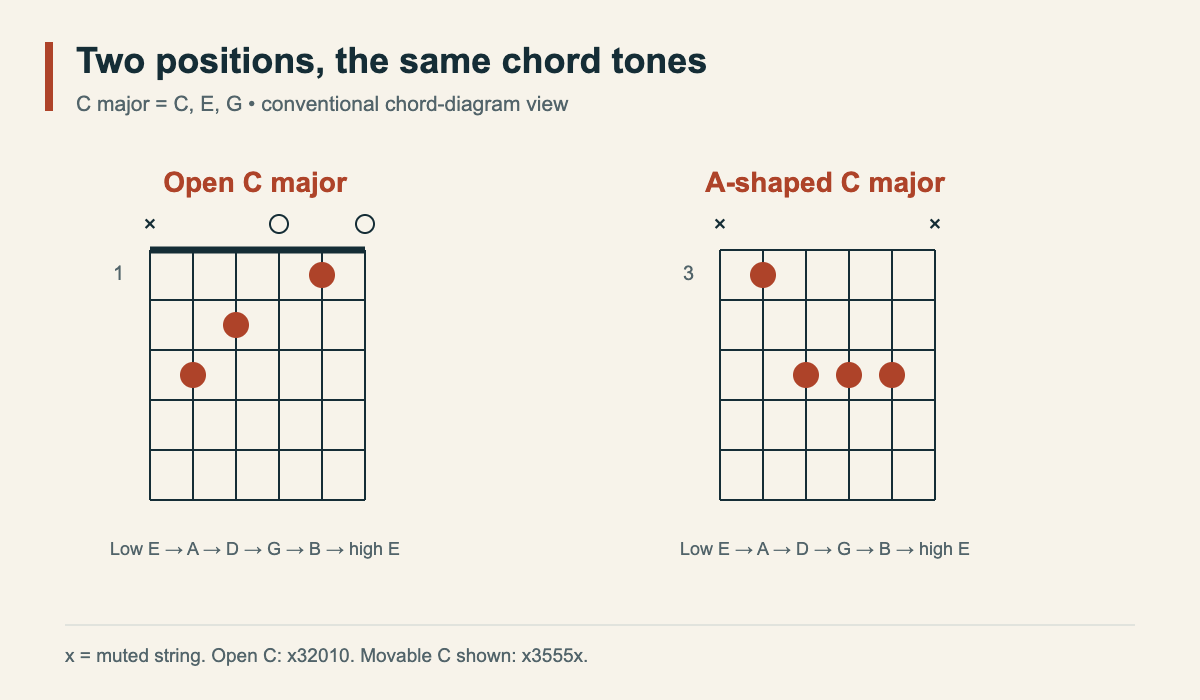
Connect two views of C major
Begin with open C major. Then show C major as an A-shaped voicing at the third fret: fifth string at fret three, with the fourth, third, and second strings at fret five. Mute the sixth and first strings for this initial example.
Both voicings contain C, E, and G. Have the student find C in each, play the chord, then pick the notes individually. Compare the registers. The chord identity remains while the distribution of notes changes.
A student who cannot yet hold the whole voicing can begin with a smaller subset. Keep the root and chord-tone explanation visible so a reduced fingering still teaches the relationship.
Put the chord into a phrase
Play a simple C-to-G change using comfortable voicings, then repeat it with the new C voicing. Ask which version makes the handoff easier and how the change affects the musical line at the top of the chords.
The goal is not to declare one position superior. It is to give the student another intentional choice. The teacher can later connect that choice with accompaniment, melody, or improvisation according to the student's level.
Assess a new task, not a repeated picture
Ask the learner to locate the root in a second A-shaped major chord, name it, and play a small part of the voicing cleanly. Then return to the musical phrase. That transfer reveals more than a successful imitation of the first demonstration.
Staff discussing lessons should describe what the learner will be able to do: identify roots, connect voicings, hear chord tones, and apply a position in music. Avoid promising complete fretboard mastery in a fixed number of sessions.
Keep the diagrams accurate and usable
The original illustration with this article compares open C and the A-shaped C voicing. It shows strings from low E on the left to high E on the right, viewed as a conventional chord diagram. Left-handed learners may benefit from an appropriately mirrored version and a clear explanation of its viewpoint.
Use the paired SBO+ songwriting project when a learner is ready to turn chord and melodic choices into an original piece. Ask the student to preserve an idea, revise it, and explain the change. CAGED can supply useful locations on the instrument; the student still supplies the musical purpose.