
A customer points to "this bit near the strings" and describes a buzz. Before anyone can discuss a repair, the store needs a shared description of the instrument and the symptom. A labeled diagram helps, provided it leads to better questions rather than an amateur diagnosis.
Use the original illustration with this article to orient new staff and customers. It shows a conventional acoustic-guitar layout. Electric, nylon-string, headless, and other designs can differ, so compare the drawing with the actual instrument in front of you.
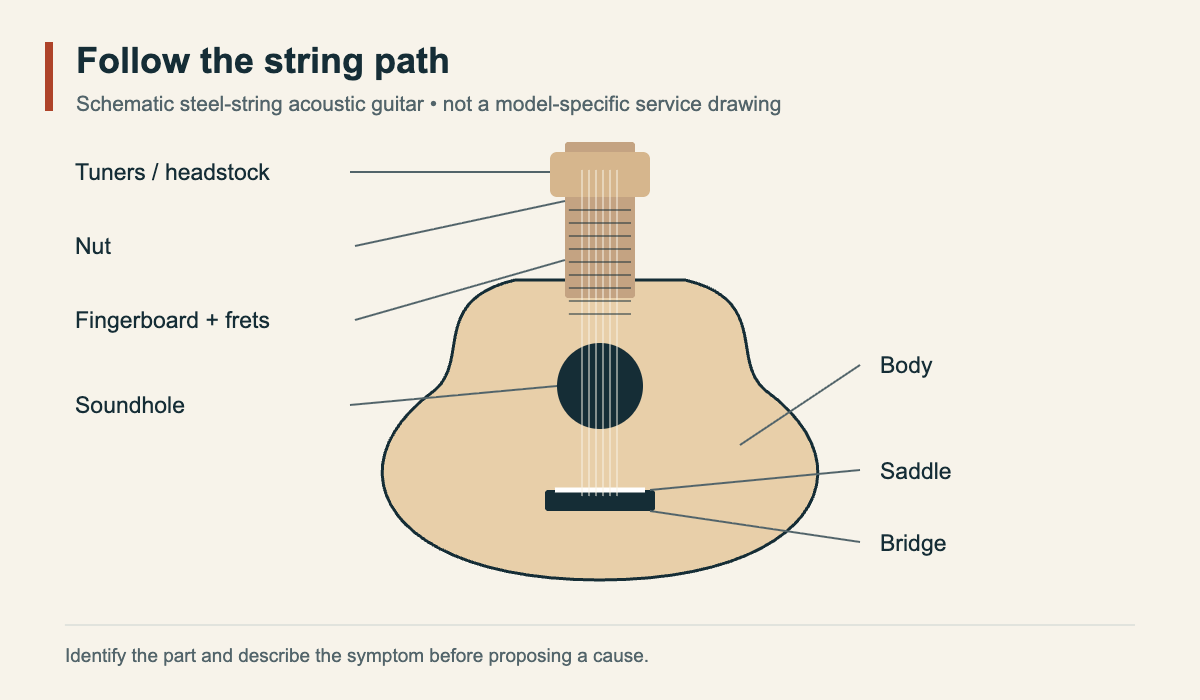
Follow the string path
Start at the tuners, where string tension is adjusted. The string passes over the nut near the headstock, along the fingerboard, and across a saddle supported by the bridge. The exact arrangement varies with the design.
Ask the customer to point to the area they mean. "Near the nut on the second string" gives the service desk more to investigate than "the top sounds wrong." Confirm whether "top" means the headstock end, the face of the body, or a higher pitch.
Scale length describes the designed vibrating string length. A common practical reference is twice the distance from the nut to the twelfth fret. Saddle positions include compensation, so measuring to a particular saddle is not always the clearest way to identify the nominal scale.
Distinguish fingerboard, fret, and fret space
The fingerboard is the surface beneath the strings. Frets are the raised metal elements that define stopped pitches on a conventional fretted guitar. Players often say "at the fifth fret" when describing a finger position in the space just behind that fret.
That everyday language is workable. For a service report, be more exact: which string, which fret position, and whether the sound occurs on an open or fretted note. If the symptom appears only under a particular attack, have the customer demonstrate that too.
Separate the bridge from the saddle
On many steel-string acoustics, the bridge is the wooden structure attached to the body, while the saddle is the narrow bearing surface over which the strings pass. Bridge pins, where fitted, help retain the strings; they are not the saddle.
Electric-guitar bridges may combine separate adjustable saddles with other hardware. Do not infer an adjustment method from the acoustic diagram. Identify the model and its documentation before discussing work.
Customers need enough language to report a concern. They do not need an invitation to turn unfamiliar screws. Staff should follow the store's service procedure and refer adjustments to appropriately trained people.
Explain controls on the actual instrument
On an electric or acoustic-electric guitar, identify the pickup arrangement, output jack, switches, and controls that are present. Demonstrate one control at a time and return it to a known setting before moving on.
A knob's location does not prove its function. Nor does an unfamiliar switch necessarily indicate a fault. Confirm the design, especially on used or modified instruments, and label unknown details as unknown until they are checked.
Turn a symptom into a useful service note
Record the instrument, tuning, fitted string information if known, exact location of the symptom, and conditions that reproduce it. Add photographs where the store's process permits and where they help identify the part.
Write "buzz on the open D string; not heard when fretted at the first position" rather than "bad nut." The first statement preserves an observation. The second announces a cause that has not yet been established.
Clear anatomy makes that distinction easier. It helps the customer explain the problem and lets the technician begin with what was actually heard or seen.