
A left-handed customer should not have to resolve the store's inventory problem before discussing their own playing. Start with experience, comfort, musical goals, and the orientation they use or want to try. Then explain what can be demonstrated and what would need ordering.
Some left-handed people play right-handed instruments. Others prefer a left-handed layout. Hand dominance alone is not enough to prescribe one route for every beginner. Give the customer usable information and, where practical, a chance to explore the alternatives with an instructor.
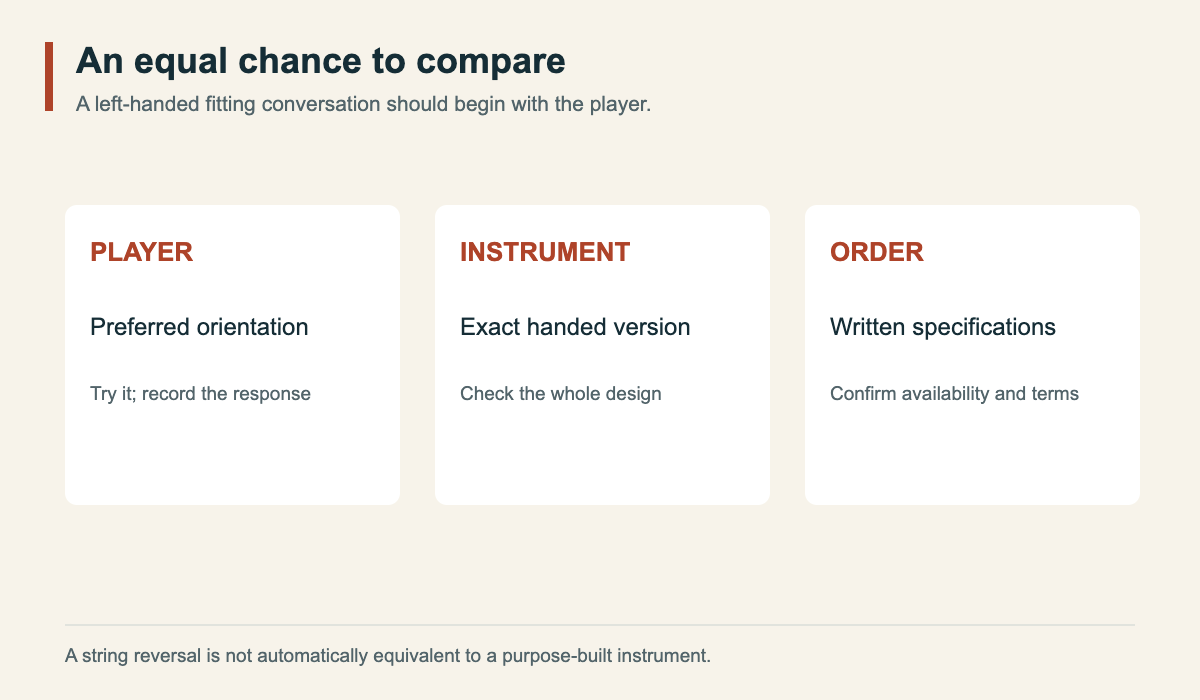
Establish what the player already does
Ask an experienced player how they currently hold the instrument and what they want to change. For a beginner, demonstrate how picking and fretting work in each orientation. Avoid describing one as the normal way and the other as an exception that must be justified.
A short appointment with a teacher can be useful when the customer is uncertain. Keep that discussion about the learner's response and goals. Do not promise that a particular orientation guarantees faster progress.
Check the whole instrument
A guitar cannot always be converted satisfactorily by reversing its strings. Nut slots, saddle compensation, bridge design, controls, cutaways, and internal construction may affect the result. Some instruments can be adapted; the actual design and required work must be evaluated.
Do not offer a casual conversion as equivalent to a purpose-built instrument. If the shop proposes one, obtain a technician's assessment and give the customer a written description of the work, limitations, and cost through the store's normal service process.
Offer an honest demonstration
When a suitable left-handed instrument is available, use the same fitting process you would offer any player: seated reach, neck comfort, balance, fretting effort, and the musical passages the customer expects to play. An amplifier demonstration should use settings the customer can understand and repeat.
If the available sample differs from the intended purchase, identify the differences. A similar body or neck can inform part of a decision without proving that the ordered guitar will feel identical. Record what was tried and what remains untested.
Make ordering details explicit
Confirm the exact handed version and product code. Check finish, electronics, case, current availability, delivery estimate, deposit requirements, and return or exchange terms. Use the supplier's current information and the store's written policy.
An estimated arrival date should remain an estimate. A customer can make a better decision with a realistic account of the order than with a reassuring date that has no firm basis.
For school orders, ask who will use the instrument, how it will be stored, and whether compatible teaching materials and service arrangements are available. Avoid buying an orientation solely because it is easier to obtain.
Include the lesson route
Explain how chord diagrams, tablature, demonstrations, and classroom seating will be handled. Standard chord symbols and the underlying musical relationships remain the same, while visual teaching materials may need orientation-specific presentation.
Show the learner one relevant example and ask them to use it. A diagram described as "left-handed" is only useful if the learner can connect it to the instrument without guessing which view it represents.
Record the customer's choice
Keep the orientation tried, the customer's observations, the selected model, and any unresolved fitting or order questions. That note lets another staff member continue the conversation without asking the customer to defend the choice again.
The goal is straightforward: a player who can evaluate the instrument on musical and practical grounds, with the same care the store gives every other customer.