Having opened ears in October when debuting during the Bristol, UK-hosted Machina Bristronica 2025 event showcasing electronic music culture and technology, dedicated DACS Audio brand Fck With Sound is proud to ship Break On Through and Bring It On — opening an absorbing new chapter in the award-winning high-performance, well-engineered product producer’s four-decade-spanning design and manufacturing history with a FET distortion unit (based on an extension of what was originally a microphone level limiter) and a ring modulator boasting a super-smooth sound, really low breakthrough, and switchable WEIGHT and EDGE controls (which will both be familiar to users of DACS Audio’s legacy FwS FREQue, much-lauded as a 2U rack-mount, two-channel ring modulator outboard effect), respectively, representing extraordinary Eurorack modules living up to the newly-launched brand’s noteworthy name — as of December 15…
As a FET distortion unit based on an extension of what was originally a microphone limiter, the basic circuit behind Fck With Sound’s Break On Through module has been used — and abused! — by producers for years, more recently emulated as a plug-in, before being effectively adapted to join the ranks of the ever-expanding Eurorack marketplace. Maintains DACS Audio Managing Director Dr Douglas Doherty: “After reading about Soundtoys’ Devil-Loc plug-in, I was intrigued. We were looking for a distortion unit to go in a mic pre under development. I had heard about Tchad Blake’s work with the original Shure Level-Loc — particularly on drums, and this seemed like a bit of serendipity that had to be acted upon! The perfect fit. In the end, we didn’t proceed with the mic pre, but it was clear that this would be ideal for modular system users.”
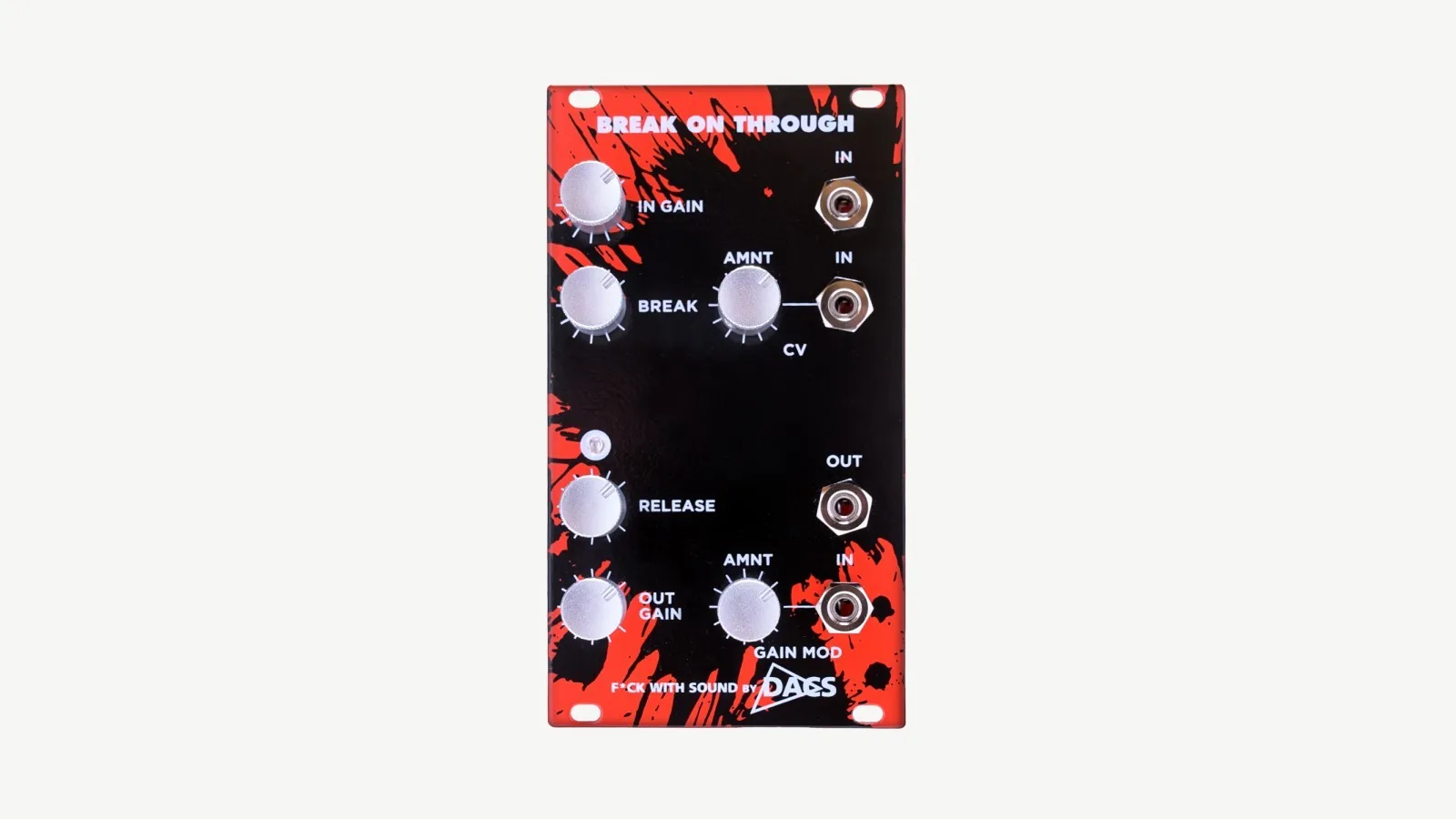
Bringing Break On Through to market as a 14HP-sized Eurorack module — based on a classic analogue microphone limiter design that was, according to legend, hijacked by an electronics-savvy record producer, and used on numerous records for ‘breaking through’ with drums and percussion, particularly — was easier said than done, however. “As always, there were many hurdles,” admits Dr Douglas Doherty, before continuing: “The original circuit was for microphones, so it had to be upped for line level; it was single voltage rail, so had to be adapted for dual voltage rail; the interaction of the threshold and input gain needed some tweaking; and we wanted to adjust the release.
After a few prototypes, we arrived at the current unit, which is very responsive and versatile. Control-wise, it has an input gain IN GAIN and a threshold setting, which we call BREAK; as well as the manual BREAK control, there is also a CV input IN to modulate the threshold. There is a variable RELEASE control that can produce some very interesting results, depending on the nature of the input. On the output, we also have gain OUT GAIN], and a CV input IN to modulate the output level GAIN MOD].”
For more information, visit fwithsound.com.