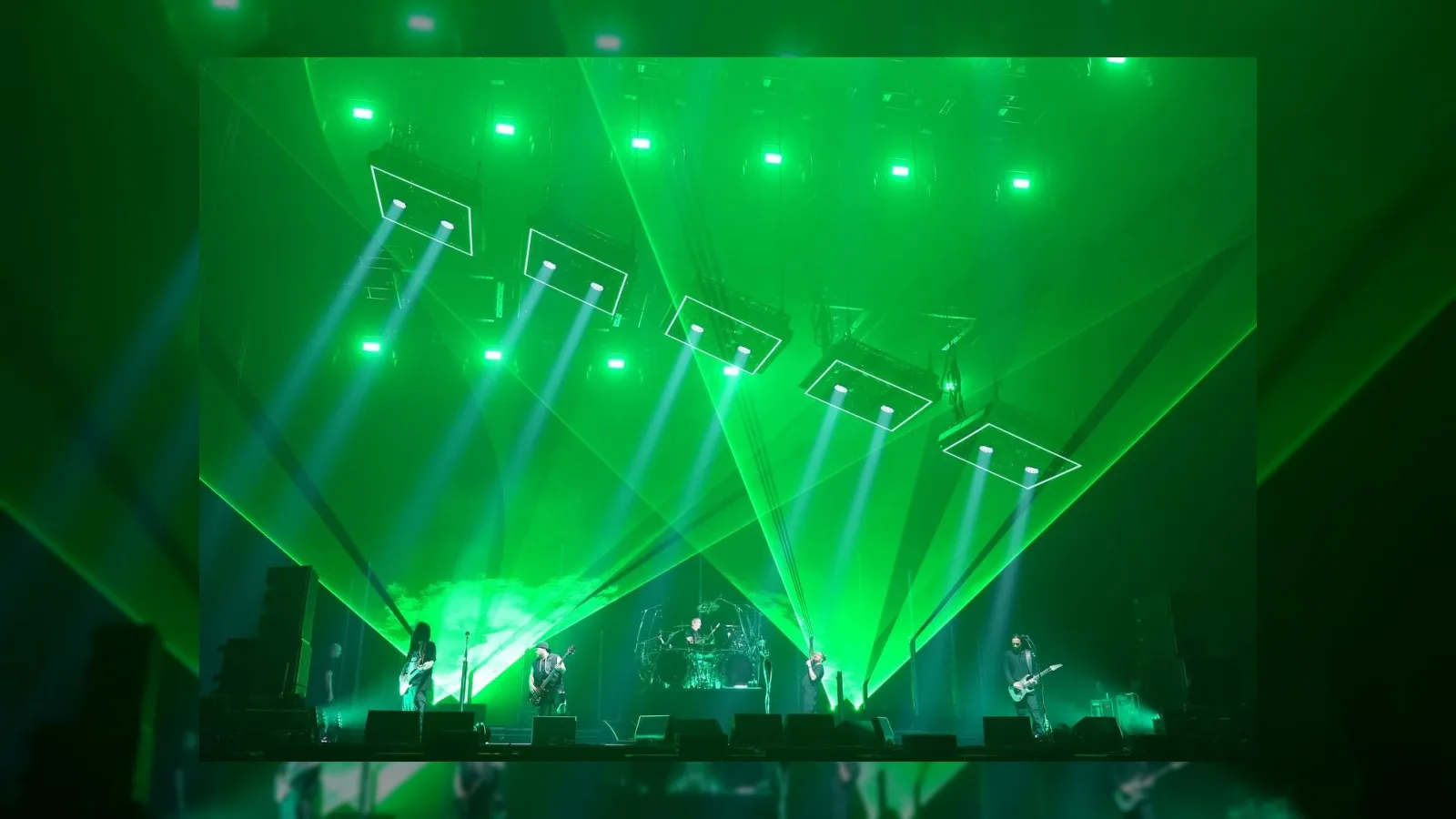
What you see is not always what it appears to be. This timeless reality check can make things a bit uncertain at times, but on the flip side, it can also lead to some wonderfully surprising moments. Such was the case with the production design that Rob Lister and his team at IYA created for the recently completed KORN world tour.
With its towering trim and floating automated light pods, the tour’s production immersed and captivated fans on a multitude of levels, but though the show was majestic, the underlying lighting element behind it was straightforward, according to Thomas Church Christmann of CycoVision.
Christmann was in a great position to know– he was the programmer and LD for the tour, powering his show with a ChamSys MagicQ MQ500M+ Stadium console. Rob and the IYA team did an incredible job, he said. They gave me all the freedom to program the show throughout, which was great fun. As for the basic structure of the show, in terms of lighting, it was straight and basic. However, with all the lasers and pixel lines involved, the end result was actually very complex. We did a great deal of video mapping on the lighting fixtures.
Often running lighting fixtures as video surfaces and using his PRG-supplied lighting rig to run through myriad colors and beam angles Christmann conjured up deeply evocative looks that belied the relatively limited number of fixtures in the production.
So, the show itself, if you’re talking about just our setup, was over 100 universes, which may sound weird, because we weren’t using that much equipment, he explained. However, we were doing a lot of video mapping, and all these fixtures were in the highest mode so we could have the best pixel pitch on them. We wanted to map every pixel they provided. This ate up a lot of universes, because I merged the server universes in my ChamSys console to the fixtures. So, that kind of doubled up the universes we used.
The lasers in our rig also used a lot of universes per unit, continued Christmann. There were six lasers-outs per stick and eight laser bars per pod. In total it was about 400 Laser outputs. So that gave us another 40 universes. But considering everything together it was about 125 universes plus the local universes. I also left 100 universes open for festivals. You never know these festivals kind of go crazy sometimes, so I want to have enough spare universes.
Given the number of universes his rig demanded, Christmann was happy to have a powerful console like the MagicQ MQ500M+ at his disposal. Capacity was the most important thing to me, he said. I had 400 DMX universes output out of the box for the production. So, it was easy for me to set ranges and put everything so far away without any trouble. I had to work with all the different house rigs on the tour, some of which could be quite large. I could go very big in terms of universes and keep my patch and build clean and easy.
We ran two different protocols: Art-Net and sACN, continued Christmann. In the end, I was connected to lighting, the lasers and video, because the video got merged in my console. There were 40-watt lasers on the floor that I was controlling over the Pangolin system. I was still connected to the console, which was running the laser batten because there must be a laser tech with the right knowledge, since the lasers are so strong.
For more information, visit chamsyslighting.com.