An appreciation of the amazing achievement that is Analogue Solutions’ Series 700 benefits, beyond any doubt, from an appreciation of its inspiration’s illustrious history. Roland’s revered, not to mention rarefied, System 700 was the most expensive synthesiser that the Japanese giant ever made — markedly more so than the company’s classic Jupiter-8 analogue programmable polysynth that dominated charts and stages throughout the early Eighties. Even though the System 700’s six so-called blocks could be bought separately to create a complete studio system, inevitably it ended up in the hands — and studios — of a privileged few from the outset.
Against all odds, it forever made its mark on the popular musical landscape when playing a prominent part in synth-pop pioneers The Human League’s landmark Dare album’s chart-topping escapades, essential record producer Martin Rushent’s Genetic Sound studios-residing System 700 being credited on the original 1981 album sleeve notes, for instance. It was, and still is, a premium professional system. Today they can change hands for over £150,000.00 GBP on the second-hand market — assuming that a full system can actually be found anywhere! And even if a System 700 is found, it is usually only a partial system so finding any missing blocks to complete it is nigh on impossible.
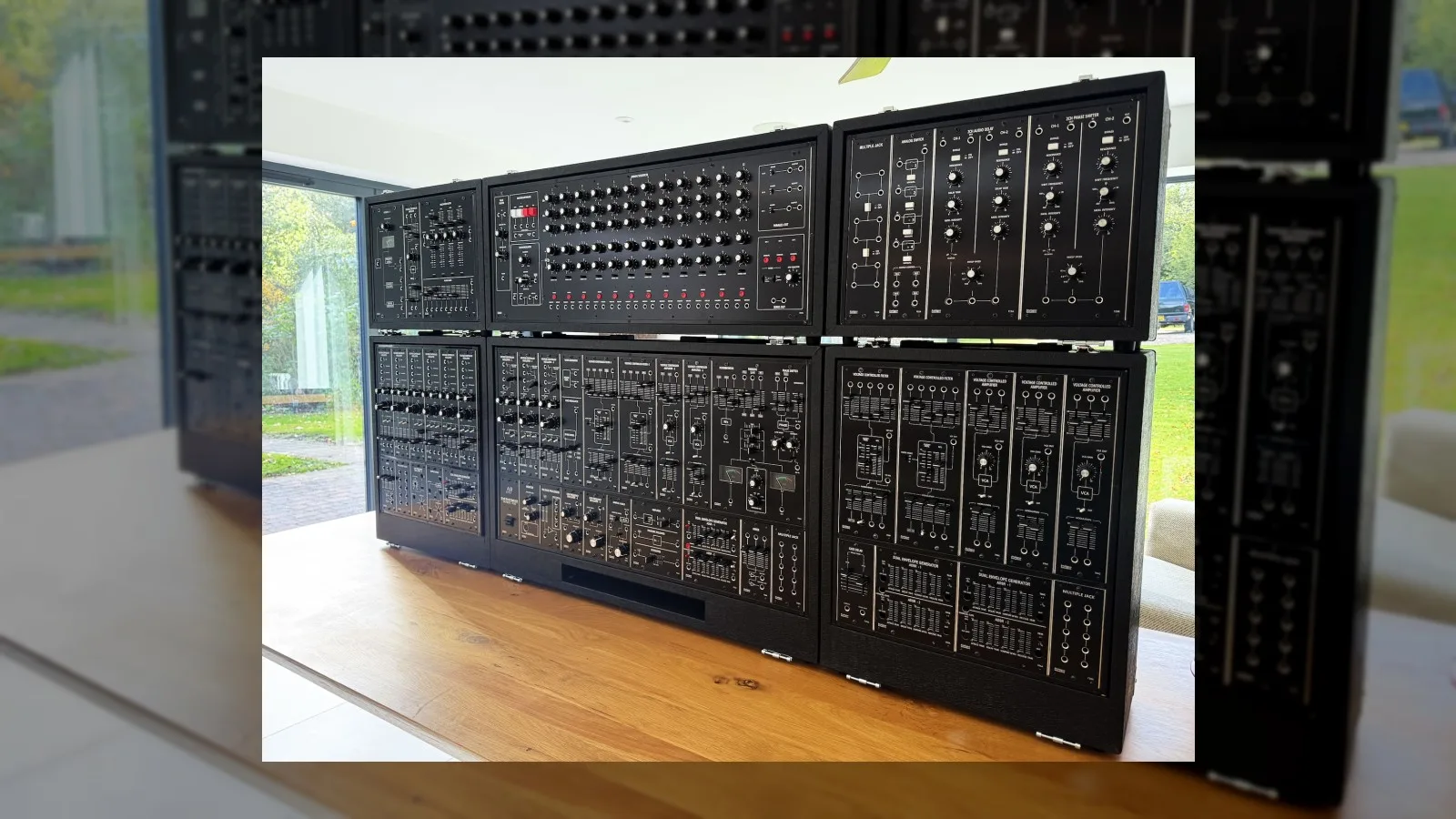
It is just as well, then, that Analogue Solutions has bravely brought its Series 700 into being, sinking a serious sum into doing just that. The end result is as close to the Roland System 700 as it is possible to get. After all, Analogue Solutions aimed to replicate the coveted mid-Seventies-vintage design as closely as possible. Put it this way: the British boutique electronic instruments innovator’s dogged pursuit of retaining the original’s distinctive look and layout even extended to having custom- made knobs — including dual-concentric fine/coarse tune controls for the VCO (Voltage-Controlled Oscillator) waveforms — and slider caps, as well as custom- ordered switches and potentiometers. And although mechanical changes have been applied internally, these do not, of course, change the sound.
Saying that, though, with the benefit of modern hindsight, there are now better ways to achieve this undertaking, both externally and internally. Indeed, a different choice of circuit types and layouts would be preferable, perhaps, but Analogue Solutions stayed true to the original spec, so almost every circuit has been reproduced from original schematics with changes being kept to an absolute minimum, made only where necessary. Needless to say, the original mid-Seventies-vintage design uses many components that are no longer available, so changes were only made where it was impossible to source specific parts. Persistently resisting the urge to change the spec or feature set, Analogue Solutions only added a basic single-channel MIDI-to-CV converter — primarily for syncing the 3 x 12-step analogue CV sequencer to MIDI.
For more information, visit analoguesolutions.com.