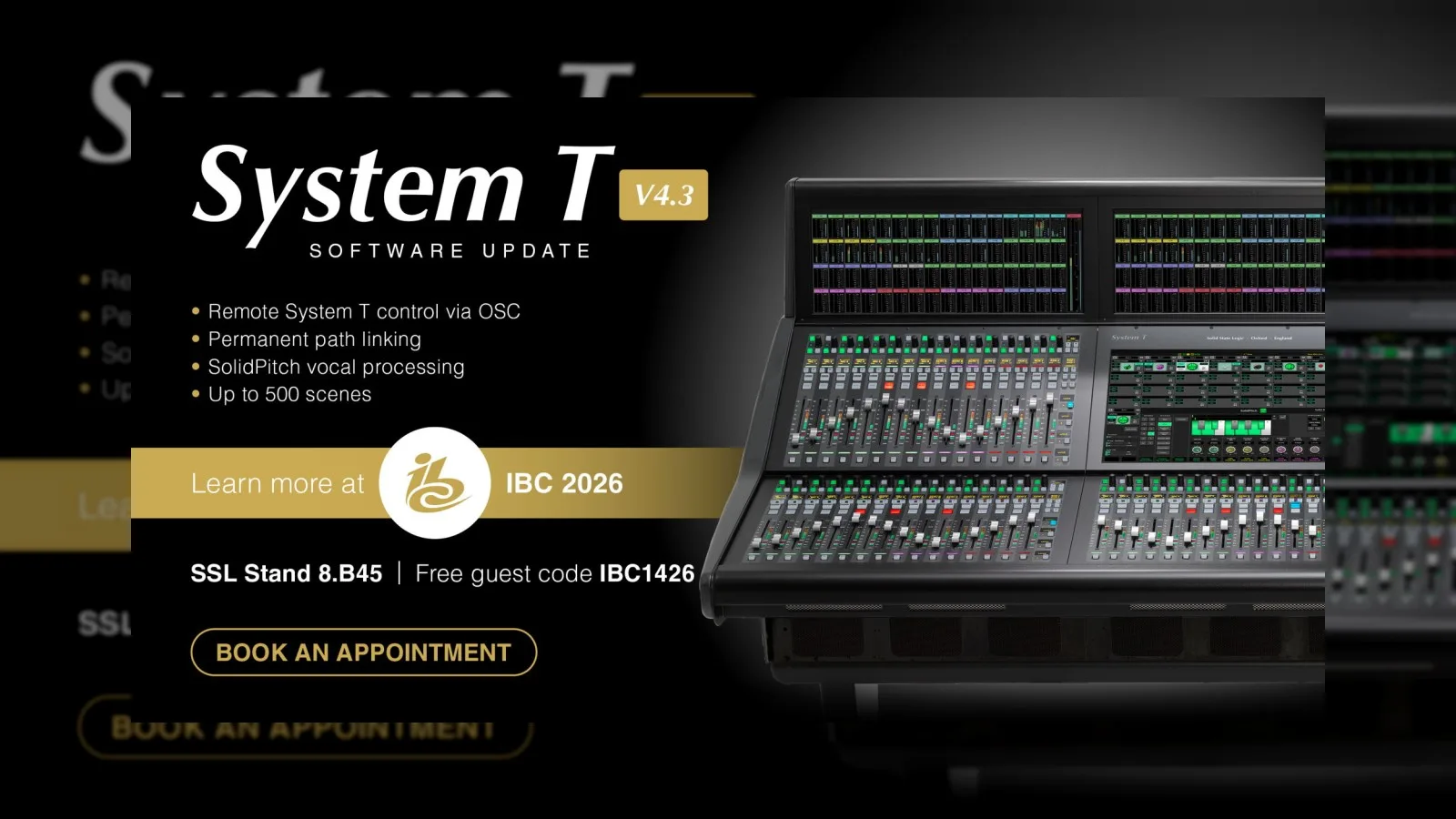
Oxford, U.K., 24th August, 2026 — Streamlining the deployment of modular broadcast ecosystems, Solid State Logic (SSL) is expanding its Open Sound Control (OSC) integration as part of a major V4.3 update to its System Tplatform at IBC 2026 (stand 8.B45). Providing the ability for external systems to control System Tconsole parameters via the open and extensible OSC protocol, the upgrade gives third-party equipment seamless access to the SSL ecosystem, supporting ad hoc workflows and enhancing flexibility and interoperability in modern production environments.
Designed to work across standard IP connectivity, SSL’s OSC integration is quick to deploy and enables broadcasters to map System T’s extensive feature set to any OSC-compliant mixer or controller, allowing remote access to System Tfunctionality via any number of third-party connectors. As broadcast workflows evolve, control needs to be increasingly flexible, says SSL Product Manager Berny Carpenter.
System Talready allows multiple control surfaces to connect with one another and SSL’s fully-featured Tempest Control App (TCA) also provides full, comprehensive control of any DSP engine in a studio or remote location. But as distributed workflows become more commonplace, remote operators often need just a limited amount of control to manage specific elements of the audio chain. Comprehensive OSC integration opens up SSL’s functionality to remotely control System Tconsole parameters without requiring dedicated SSL hardware, making throw-down systems much easier to deploy using a variety of external devices.
For example, a remote operator at a venue might just need console monitor functionality or access to select local faders – all that can be controlled via a compact hardware controller for smaller setups. That flexibility becomes a real benefit in environments wherever and whenever operational flexibility is desirable. The integration enables direct third-party control of a wide range of parameters including faders, mutes, PFL, AFL and path labels, and can be expanded to any other console functionality that is available as part of SSL’s established Event Manager feature-set.
Native support of OSC inputs and outputs in Event Manager means that OSC messages can also be used to trigger and respond to events alongside traditional external control signals like GPIO, Ember+ or MIDI. Native OSC support for scene automation also allows scenes to be fired directly by number to make life easier for broadcasters using snapshot-style recall.
Another key feature is the addition of external mic preamp control to provide control of SSL’s entire Net I/Oecosystem, allowing users to set the gain of any SSL preamp via TCA using OSC.
For more information, visit solidstatelogic.com.